
The bottling plant of Coca Cola FEMSA in Montevideo is one of the few in the world that uses refillable PET bottles, which allows for the returned bottles to be refilled in an eco-friendly way. But not all bottles are returned and not all returned bottles are in condition to be refilled. Because of this, new bottles need to be entered into the filling production line to compensate those that are lost.
The first challenge in this is ergonomy, as the pallets of new bottles that must be sent into the filling production line are more than 2 meters tall, with 6 layers of bottles and 121 bottles in each level, which made the unloading of the bottles manually a complicated task. Secondly, matching the required maximum speed of 16.000 bottles per hour meant that many operators needed to be working on this task.
Automating the depalletizing process was proposed to supply the production line while needing less manpower.
The solution designed by Pensur consists of a Kuka KR120 R3200 PA palletizing robot using a custom gripper designed and manufactured by Pensur for this application. This gripper allows the robot to grab a whole layer of 121 empty bottles at once using pneumatic actuators and pick the interlayer cardboard using a vacuum system. Aditionally, it uses the same gripper to manipulate the empty pallets and pile them for a forklift to take out.
The system operates automatically in coordination with the filling line, which dictates if new bottles need to be entered. A pallet conveyor system is responsible for entering the pallets into the cell and leaving a new pallet available for depalletizing whenever available. The intervention of an operator is only required when, after a pallet of containers is loaded on the entry transport, they must remove the film wrapper and give the order for the pallet to be entered into the cell.
The depalletizer has a control panel to give commands to the system, make configurations and view statistics and events. Additionally, the communication of statistics and status of the system to the plant SCADA was implemented.
For the design and implementation of the depalletizer, a risk assessment was carried out and the most demanding safety regulations were followed. All cell entrance doors have safety interlocks, multiple emergency buttons, and the pallet entrance has a laser safety barrier with muting. In addition, best security practices for the programming of the system were followed, especially in the events that there are entrances to the cell to guarantee the safety of the operators.
During the whole design, installation and commisioning process, we worked closely with the client to adapt every aspect of the project to their needs and workflow.
The implemented depalletizer system meets all the desired requierements and has the capacity to increase production. The gripper designed and manufactured by Pensur enabled the robot to have the perfect tool for the job without compromising in other aspects. Finally, the depalletized allowed to decrease the amount of personnel occupied with the task of entering new bottles into the REFPET line.
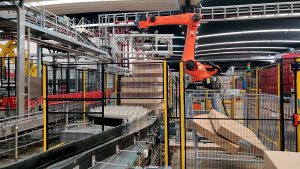
During the refinement and packaging process, Azucarlito’s sugar refinement plant works 24 hours a day, packaging and palletizing 7 different formats of sugar bags at a maximum cadence of 1500 bags per hour. Originally, this task required a high rotation of manpower due to the physical fatigue of carrying bags of up to 25 Kg.
Automating the palletizing process with robots was proposed to achieve consistent results and to elliminate the more physically demanding tasks that can cause long term health issues.
The solution designed by Pensur consists of 2 Kuka KR120 R3200 PA palletizing robots working in parallel, one dedicated entirely to 25 Kg bags for industrial use, working at a maximum rate of 700 bags per hour, and the other robot dedicated to the 6 formats of multibags (bags containing mulitple consumer sized bags), working at a maximum rate of 800 multibags per hour.
Both robots use grippers designed by Pensur that integrate vacuum technology from Coval to grab the bags using suction, which makes the process much faster, simpler and easier to maintain rather than a mechanical gripper. Both robots use this same gripper to also manipulate the interlayer cardboards, which they place in the corresponding layer according to the selected format. Additionally, the multibag palletizer robot can palletize two different pallets at the same time using different formats in different lines, for a total of three separate palletizing lines.
Aside from the robots, the palletizing cell has a pallet dispenser and a conveyor system that feeds empty pallets to all lines automatically, reducing to a minimum the exchange time between the exit of a finished pallet and the start of a new one.
The whole system works automatically and each line can be operated independently. Multiple control stations are placed around the cell for quick operator control and a screen can be used to make configurations, view statistics and events.
Due to the high speed, reach and force of the robots, security is paramount. The cell has multiple doors with monitored safety interlocks, emergency stop buttons and safety light barriers with muting to enable the exit of finished pallets. All these sensors, together with a safety analysis and correct implementation of safety standards make the system exceptionally safe for operators.
During the whole design, installation and commisioning process, we worked closely with the client to adapt every aspect of the project to their needs and workflow.
A robust and efficient implementation of the multi-format sugar bag palletizer system was achieved, maximizing the use of the available space. Thanks to the utilization of industrial robots and first grade components and materials, the system works without interruptions or major interventions. The implementation of the palletizing system allowed the improvement of the consistency of the palletizing, as well as the safety of the operators, with the flexibilty of being able to make format modifications in the future with only software changes.
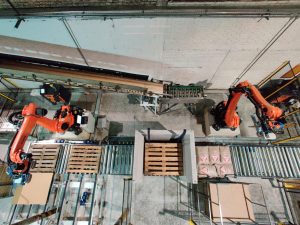
Previously, the process of sorting and packaging products consisted of two stages. First, for each product line to be packaged, products had to be manually organized and placed into boxes for easier access at the next stage. After that, an operator would insert each product box into a blister molded by the machine. This type of manual labor makes operators prone to work related injuries by repetitive movement, as tens of thousands of products are blistered every day. The project’s objectives were to automatize the blistering process and to reduce the need for intensive manual labor when sorting and placing boxes in the blisters, while being able to match the speed of the blister molding machine.
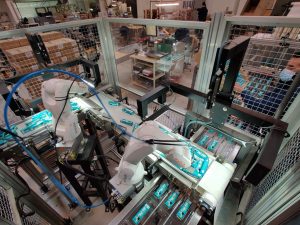
The solution developed by Pensur is a system that combines robotics and computer vision, in which two robotic arms are guided by industrial cameras using specifically developed software for this application.
The system receives the product boxes in an unordered manner. Then a conveyor moves them to the workspace of the first robot, where a camera identifies the orientation and position of each box and transfers this information to the robot which reorients them so they are ready to place into the blisters. Then, the correctly oriented product boxes are transfered to the second robot’s workspace, where another camera determines the position of each box, whether it is correctly orientated and if it is defective in some way. Correctly oriented products are then placed into blisters by the second robot matching the cadence of the molding machine. The whole process automatically adjusts to the speed of the molding machine and can reach up to 45 boxes per minute for the over 30 different products available.
Placing the boxes into blisters requires the pick and place error to be less than 0.5mm, so a custom calibration procedure between robots and cameras needed to be developed to achieve it. Additionally, custom easy-to-use product training tools were developed for the client to re-train the vision system when the product’s designs are changed.
The whole solution was developed entirely by Pensur using hardware from our strategic partners like Kuka, Lucid Vision, Siemens and Coval.
The pick and place system brings cost savings and increases employee’s productivity and safety on the production floor by maximizing labor efficiency and a high throughput. Also, the custom software also allows the client to automatically adjust and train the system to keep up with the ever changing designs in products without continuous interventions and reducing downtime.